Heraldry for Beginners: Understanding the Language of Coats of Arms
A coat of arms is not a picture. It is a sentence. That one idea clears up most of what puzzles newcomers: why a shield full of beasts and stars gets described in a few clipped words, why the colours have such odd names, and why anyone bothers to write it down at all. Heraldry began as a practical way of identifying an armoured man in a crowd, and its language was built for precision. Learn a handful of rules and you can read a coat of arms you have never seen before.
Blazon: The Written Language of Arms
The formal description of a coat of arms is called a blazon. It is not decoration and it is not poetry; it is a set of instructions for drawing. A blazon follows a fixed order: the field, meaning the background, comes first, then the charges laid upon it, taken from the centre outwards or from the top downwards.
Two habits trip beginners up. First, the colour is named after the object it describes, so we say "a cross Gules", never "a red cross". Second, the vocabulary is largely Old French, which is why red is Gules and silver is Argent. Accept that and the grammar is straightforward — adjectives follow nouns, and anything a herald can safely assume is left unsaid.
So Azure, a lion rampant Or means: a blue field bearing a gold lion rearing up. That is a complete blazon. An experienced herald could draw it without asking a single question.
Tinctures: Colours, Metals and Furs
Heraldry uses a small, closed set of colours, and learning them is most of the battle. There are two metals, five colours and a few furs.
- Or — gold, shown as yellow
- Argent — silver, shown as white
- Gules — red
- Azure — blue
- Vert — green
- Sable — black
- Purpure — purple
Furs such as ermine, with its rows of little black tails, and vair, with its blue and white bell shapes, began life as actual fur linings. A charge can also be blazoned as proper, meaning it appears in its natural colours — a brown falcon, a green oak.
The rule of tincture says that metal should not sit on metal, nor colour on colour. Its purpose is legibility: a gold lion on a silver field blurs into one pale shape at any distance. Treat it as a strong convention rather than an unbreakable law, because genuine arms do break it. The arms of the Kingdom of Jerusalem, with gold crosses on silver, are the famous exception.
Charges and Ordinaries
A charge is anything placed on the field. The earliest and simplest are geometric bands known as ordinaries: the cross, the pale, the fess, the bend, the chevron and the saltire, plus the chief across the top and the bordure around the edge.
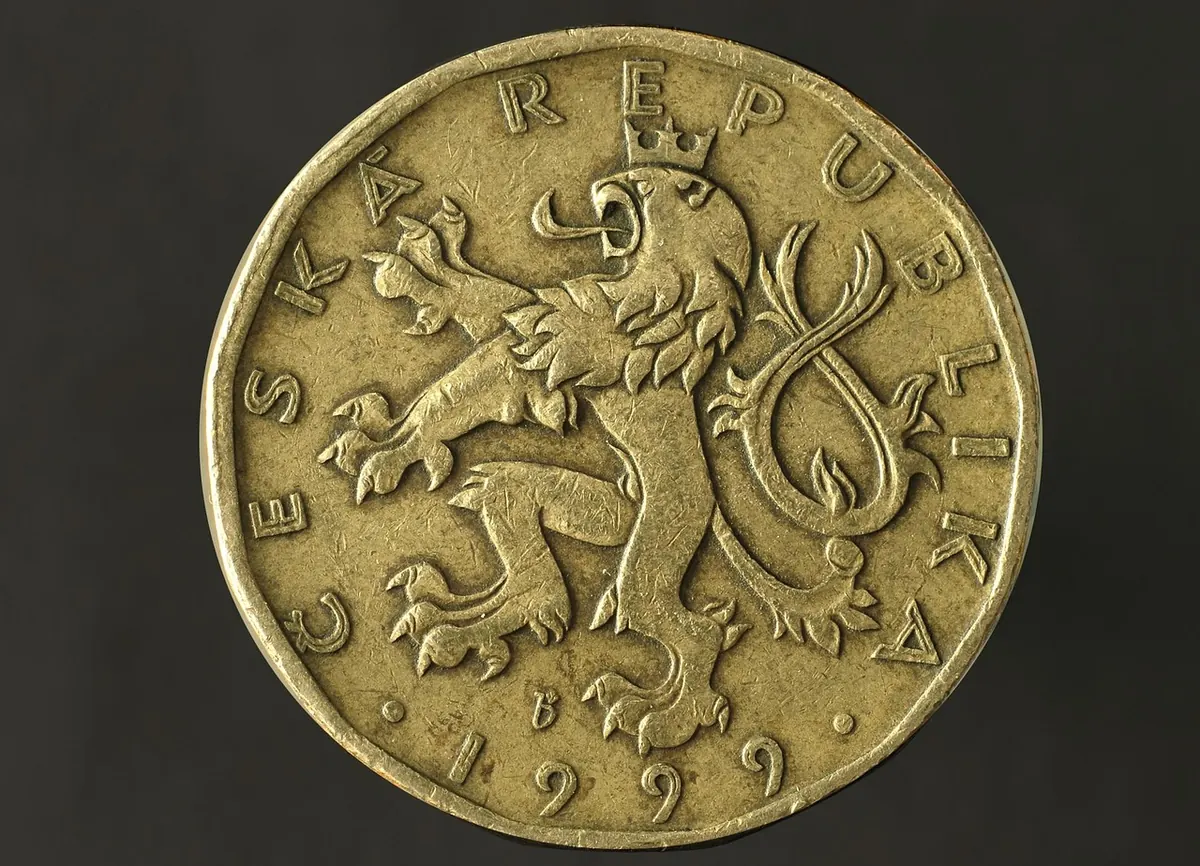
Beyond those come the memorable things: lions, eagles, stags and boars; fleurs-de-lis, keys, ships, towers and sheaves of corn. A lion, for instance, can be shown in a range of attitudes.
- rampant — rearing up on the hind legs, the classic pose
- passant — walking, one forepaw raised
- statant — standing still
- sejant — sitting
- couchant — lying down with the head up
- salient — leaping
Direction matters as well. The dexter side is the shield's own right, which is your left as you look at it; the sinister is the other. Unless a blazon says otherwise, charges face dexter.
Reading a Blazon, Step by Step
Take a short example and work through it slowly.
Gules, on a chevron Argent three mullets Sable.
- The field is Gules: red.
- Lying on it is a chevron, Argent — a silver inverted V.
- Set on the chevron, not on the field, are three mullets, Sable: black five-pointed stars, which heraldry calls mullets rather than stars.
Field first, then what rests on it, then what rests on that. Because a herald omits anything obvious, a finished blazon can look terse and still be complete.
The Full Achievement: Shield, Helm, Crest and Motto
What most people call a coat of arms is technically an achievement, and the shield is only part of it. Above the shield sits a helmet, usually with a torse or wreath holding a crest. The crest is the object on top, not the whole design, which is why "family crest" is so often the wrong phrase. Mantling, the swirling cloth cut into ribbons, hangs to either side.
Supporters — the creatures or figures holding up the shield — are not universal. In England they generally belong to peers, to knights of certain orders and to corporate bodies. Beneath sits a compartment, and a motto may appear on a scroll; mottos are not part of the blazon and can be changed at will.
Where Beginner Research Usually Goes Wrong
Arms belong to a person, not to a surname. There is no such thing as "the Smith coat of arms", and a printed shield matched to your family name is decoration rather than genealogy. In England, Wales and Northern Ireland arms pass from one bearer to one heir at a time, and younger sons may difference their father's arms with cadency marks such as a label, a crescent or a mullet. Scotland uses a separate system of bordures for the same purpose.
Marriage arms are combined by impalement: the husband's arms on the dexter half, the wife's on the sinister. Heraldry in the United Kingdom is regulated by the College of Arms in London and the Court of the Lord Lyon in Edinburgh, with a Chief Herald in Ireland; a new grant of arms can be applied for, for a fee.
Getting Started: A Few Practical Steps
- Memorise the seven tinctures and the rule of tincture. Everything else builds on them.
- Read blazons aloud. The word order becomes natural surprisingly quickly.
- Sketch as you read. You will spot gaps in your understanding fast.
- Look at real arms in parish churches, on tombs, on old buildings and on bookplates, and try to blazon them yourself before checking.
- If you are tracing your own family, start with names, dates and places rather than with heraldry, and confirm any arms against a record held by the relevant heraldic authority.
Treat the vocabulary as a tool rather than a test. Nobody learns blazon in an afternoon, but a couple of hours with the tinctures and a handful of charges will let you open almost any heraldic reference and understand what you are reading.
Photo: Pexels / Pixabay

City of London Livery Companies: A Heraldic Tour
From the Mercers' crowned maiden to the Fishmongers' mermen, the City of London's livery companies carry...

Seasonal Heraldry: Christmas Symbols in Coats of Arms
Holly, oak, stars and candles: how wintry and Christmas-themed charges appear in coats of arms, how to...