Designing a Crest for a Welsh Family: Traditions and Tips
A crest has to work in a space no wider than a thumbprint. It sits on a signet ring, over a doorway, at the head of a letter, and it carries a family's story whether anyone explains it or not. Welsh families come to that job with real advantages: a deep genealogical tradition, a set of unmistakable national emblems, and a naming history that is far more interesting than most people realise. They also come with a trap or two. Here is how to work through the design without ending up with something generic.
Crest, coat of arms, and what you are actually designing
In everyday speech, "family crest" means the whole thing. In heraldry it means something narrower: the device that sits on top of the helmet, above the shield. The full achievement is the shield, helmet, mantling, wreath and crest, with supporters added only in special cases.
This matters practically. A crest is normally granted as part of a coat of arms rather than on its own, so designing one means thinking about the shield as well. It matters creatively too, because the crest is often the most useful part of the achievement: it stands alone happily on a ring, a bookplate or a gatepost, where a bare shield can look stranded.
What sets Welsh heraldry apart
Welsh arms tend to be plainer than English ones, and that is not a criticism. Where English families spent centuries absorbing heiresses' arms into ever more crowded shields, Welsh families often kept a single, strongly drawn design and put their energy into recorded descent instead. Welsh pedigrees were preserved by poets and genealogists long before the College of Arms began its visitations in Wales, and that tradition still shapes how Welsh families think about lineage.
Two consequences follow. First, a well-designed Welsh crest can be bold and legible rather than fussy. Second, a Welsh motto can be in Welsh, and increasing numbers of grants use the language. If the family has a phrase it actually says — at a wedding, at a funeral, on a plaque — that is stronger material than a Latin tag borrowed from a list.
Why surnames let you down
Until roughly the sixteenth century, Welsh naming was patronymic: Rhys ap Gruffudd, Gruffudd ap Llywelyn, and so on. When fixed surnames arrived, a relatively small set of them hardened across the whole country. Jones, Williams, Davies, Evans, Thomas, Roberts, Hughes, Lewis, Morgan and Griffiths are shared by an enormous number of unrelated families.
The practical point is blunt: a surname is not a design brief. There is no "Jones crest" waiting to be claimed. Anyone selling one is selling you the arms of a single unrelated individual who happened to share the name.
Dragons, leeks, daffodils — and the problem with all three
National emblems are tempting, and they are not forbidden. They are simply crowded.
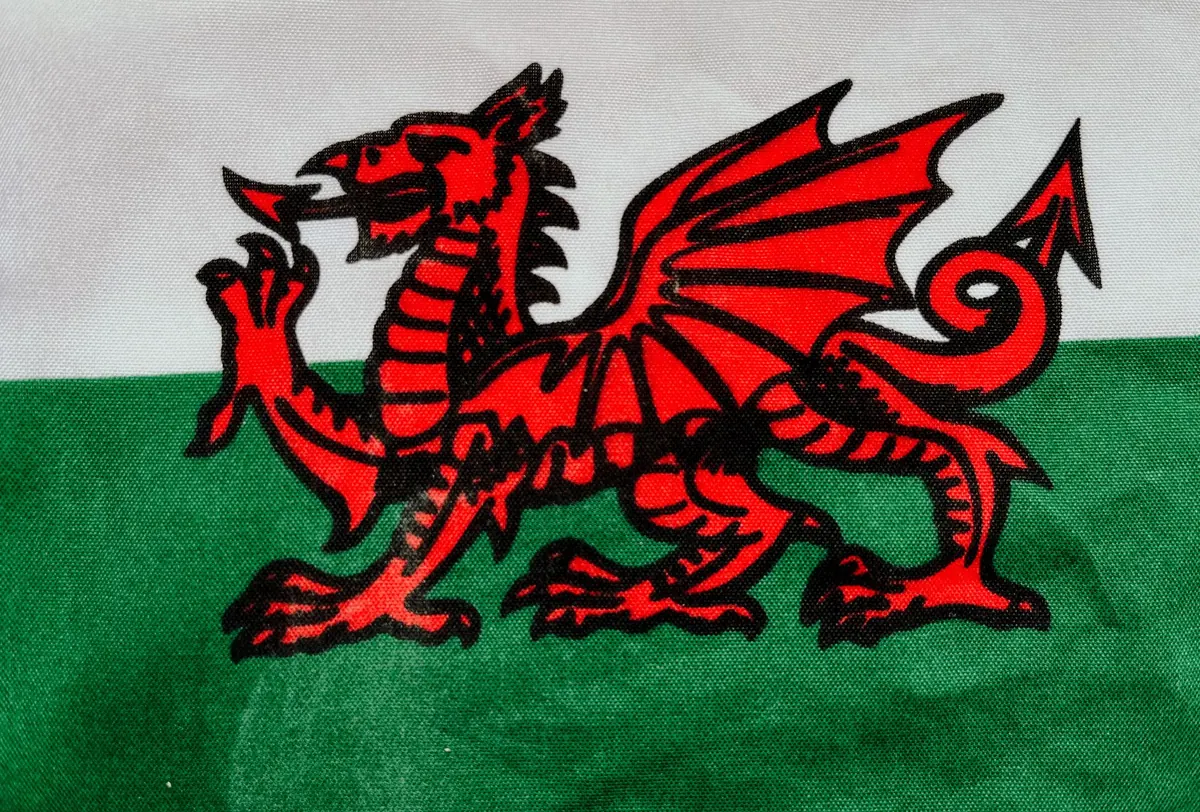
- Y Ddraig Goch, the red dragon. The most requested charge in Welsh heraldry by a wide margin, and the most common reason two unrelated families end up with near-identical designs. If you want a dragon, give it work to do: a dragon's head erased, a dragon passant, a wyvern, a dragon holding something. The posture is where you find room to be specific.
- The leek. Genuinely historic as an emblem of Wales and still worn on St David's Day, but as a heraldic charge it is a shape problem. Drawn honestly, a leek is a bundle of long green leaves, which reads as a smudge at small sizes. It can work, but it needs a confident hand.
- The daffodil. A later favourite, more decorative, and slightly easier to draw. It is also fussier, and fussy charges lose detail the moment they are embroidered or stamped in wax.
- Less obvious options. A mountain, a river in bend, a slate chisel, a ship, a raven, a goat, a border of knotwork. These say something a dragon cannot: which Welsh family this is.
Whatever you choose, remember the rule of tincture. Metals are gold and silver; colours are red, blue, green, black and purple. Put metal on colour or colour on metal. Gold on white, or blue on red, will look muddy and will be corrected by anyone who knows the convention.
Mine the family before you mine the flag
The best crests come from a question, not a catalogue: what did this family actually do? A line of slate quarrymen from Blaenau Ffestiniog, a Cardigan Bay fishing family, a Merthyr ironworks family, a farming family on the Cambrian edge — each has raw material that no other family owns. A lamp, an anchor, a hammer, a sheep bell, a particular hill.
Place works well too. A river, a bridge, a coastal headland or a parish church tower can be depicted simply, and it grounds the design in a real location rather than a general idea of Wales. Ask older relatives before you ask a designer. Half the detail that makes a crest worth having is sitting in someone's memory.
Seven rules for a crest that survives real use
- Draw it small first. Sketch it at 20mm across, in black and white, before you consider colour. If it is still recognisable, it will work everywhere.
- Limit the palette. One metal and one or two colours is plenty. Every added tincture costs clarity.
- Avoid letters, initials and dates. They are discouraged in heraldic design, they date quickly, and they are unreadable at ring size.
- Say no to clip art. Borrowed line art, logos and photographic detail all betray themselves. A heraldic artist draws in flat, decisive shapes.
- Test it in reverse and in bad light. Photocopy it, shrink it, embroider a sample. Most crests fail at the embroidery stage, not on the drawing board.
- Design the shield and crest together. They should look like parts of one object. A busy shield with a busy crest is a muddle.
- Write the blazon. The written description is what actually fixes the design. For example: Argent, a dragon segreant Gules, on a chief Vert three leeks Or. Get that wording right and any competent artist can redraw the arms identically in fifty years.
Grants, assumptions and arms that already exist
There is no separate heraldic authority for Wales. The College of Arms in London has jurisdiction over England, Wales and Northern Ireland, and grants of arms are made by the Kings of Arms under the authority of the Earl Marshal. If you are considering a grant, or want to know whether arms already exist in your family, the College of Arms is the correct first port of call, and a genealogist can research a possible descent before you spend anything on design.
Be wary of anyone offering instant "family coats of arms" by surname. And be wary of assuming arms you have no right to. In England and Wales, arms granted to one person descend to their heirs in a particular way, so a design belonging to a distant branch is not automatically yours to use.
Getting started
Decide in one sentence what you want the crest to say, then sketch it small in black and white before you commission anything. If you are working towards a grant, check the position with the College of Arms first. If you are designing for personal or family use, keep the drawing simple, write the blazon down, and file it with the family photographs. A crest designed this way earns its place — and it will still be legible a hundred years from now.
Photo: Lisa Fotios / Pexels
City of London Livery Companies: A Heraldic Tour
From the Mercers' crowned maiden to the Fishmongers' mermen, the City of London's livery companies carry...

Seasonal Heraldry: Christmas Symbols in Coats of Arms
Holly, oak, stars and candles: how wintry and Christmas-themed charges appear in coats of arms, how to...